Young Physicists Tournament Team
Starting my sophomore year, I joined my school’s Young Physicists Tournament(YPT) Team, which tackles various physics-related problems through experimentation and theory. For the 2025-2026 season, my group evaluated the limits of the Euler-Eytelwein Equation, a classical formula describing friction in rope-pulley systems—by designing and conducting experiments to identify when and why the equation breaks down under real-world conditions.
Our experiment used a metal pole (a capstan) placed on various types of rope, testing the maximum load that could be lifted with a pulley system before the capstan rolled. We explored factors like rope elasticity, surface roughness, and dynamic loading that challenge the equation's assumptions.
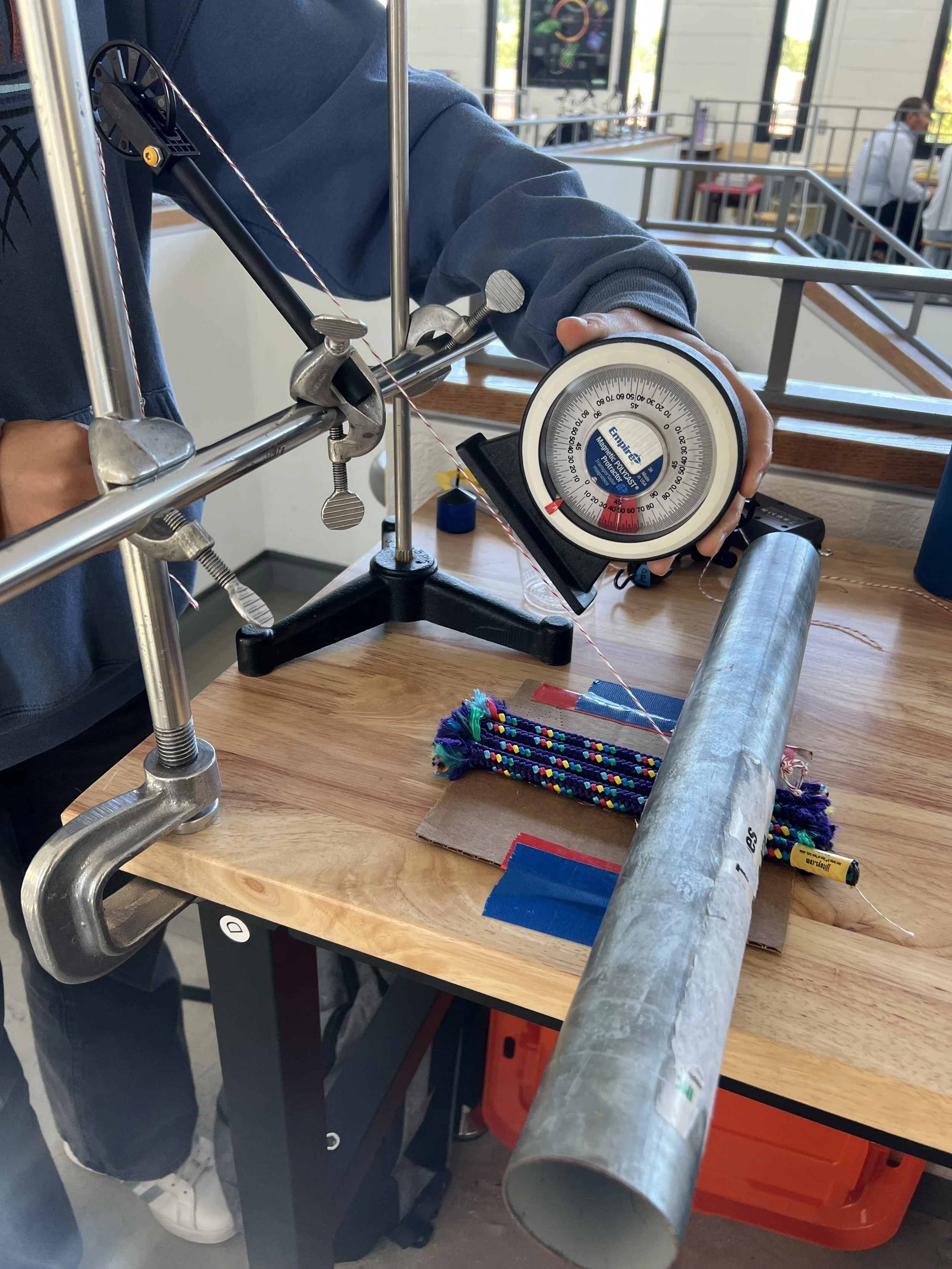
Our Experimental Setup
As one of two lead experimenters in our group, my role involved designing and executing each experimental setup, as well as brainstorming creative ways to determine variables such as Young’s Modulus and Bending Moment, both of which were crucial to the theory behind our experiments. Additionally, I was the sole contributor to error propagation and analysis, which is shown below.
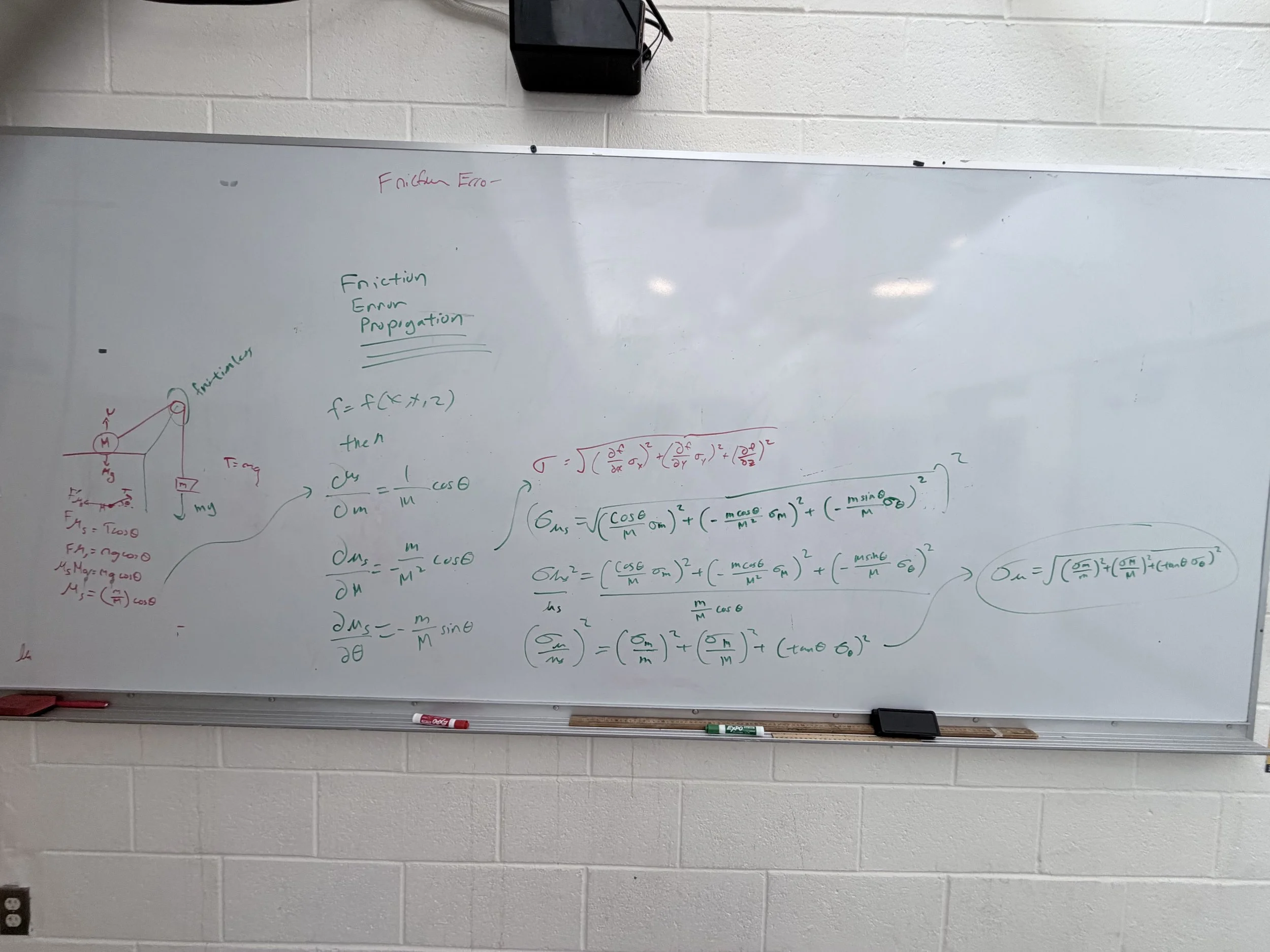
Error Propogation/Analysis for Friction Equation
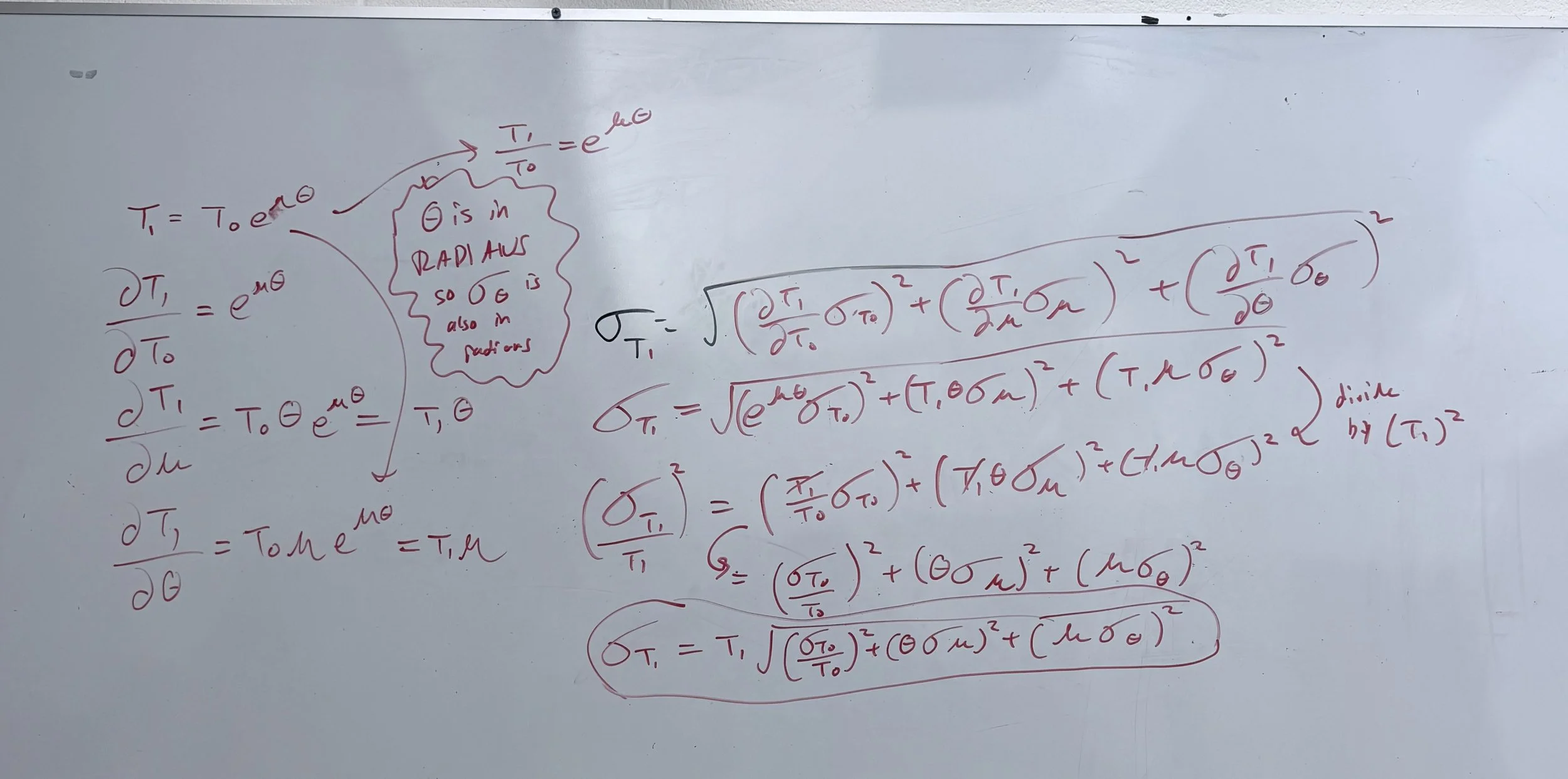
Error Propogation/Analysis for Tension Equation
Our 2026 USAYPT Competition Presentation
Our work earned us an international first-place finish in the USAYPT Competition, competing against teams from around the world. The experience taught me to approach ambiguous problems creatively, design rigorous experiments with limited resources, and collaborate effectively with teammates in a STEM setting.
